Still Standing, Still Stunning: What Asia's Ageless Performers Are Teaching America About the Long Game
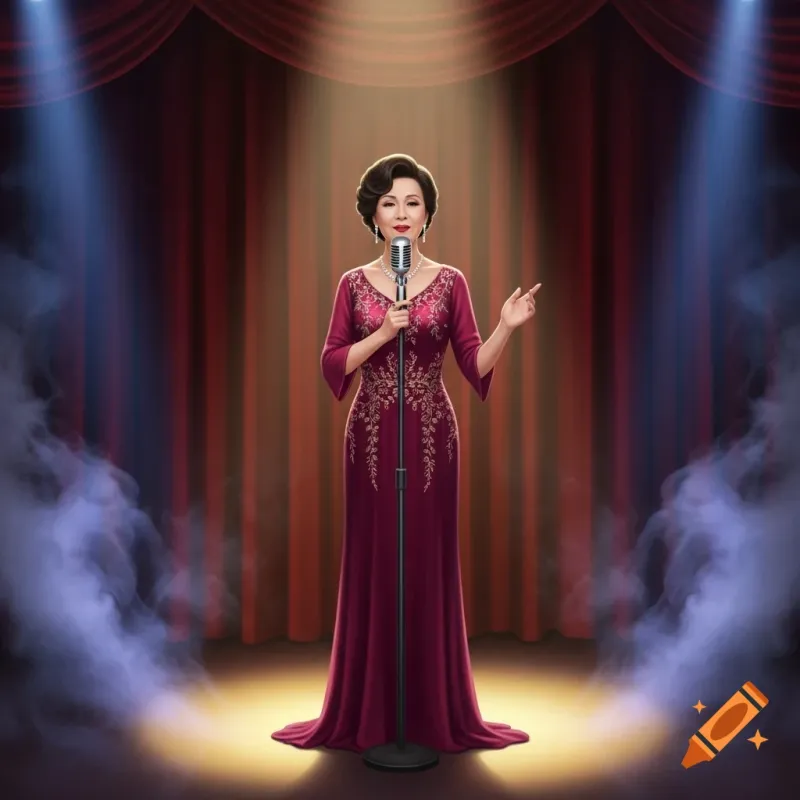
Photo: elegant Asian veteran performer stage spotlight theater aged graceful, via media.craiyon.com
There's a moment in the 2022 K-drama My Mister rewatch community threads — yes, people are still rewatching it — where fans from across the US talk about being wrecked by Lee Sun-kyun's performance. Not because it was flashy. Because it was lived in. That quality, that particular kind of depth you can only earn through decades of craft, is exactly what Asian entertainment has been quietly championing for years. And slowly, steadily, American audiences are starting to notice.
We've built an entertainment culture here that treats youth like a natural resource — abundant, renewable, and always one casting cycle away from fresh supply. But that model is starting to show cracks. Audiences are hungry for something more substantial. And it turns out, they don't have to look far. Across East and Southeast Asia, the concept of the comeback — or more accurately, the continuation — has been baked into the culture for generations.
The K-Drama Comeback Machine
In South Korea, the term "comeback" doesn't carry the same slightly desperate energy it sometimes does in the West. It's not a Hail Mary. It's more like a natural exhale after a long, considered pause. Veteran actors like Kim Hye-ja, who has been working since the 1960s, don't just return to screens — they command them. Her role in My Mister wasn't a nostalgia play. It was a masterclass.
What's striking to American viewers discovering these performances is the absence of apology. These actors don't seem to be fighting their age or working around it. They're using it. Every line on their face, every measured pause, every glance that carries thirty years of emotional memory — it's all in service of the story. That's not something you can fake at twenty-five.
The Korean entertainment industry, for all its well-documented obsession with idol youth culture, has a parallel track that runs quietly alongside it: a deep, almost reverential respect for performers who have put in the time. The two coexist, and increasingly, it's the veteran track that's drawing in global audiences craving substance over spectacle.
Hong Kong Cinema's Second Wind
Then there's Hong Kong, where the legends never really left — they just waited for the world to catch up. Tony Leung Chiu-wai's appearance in Shang-Chi and the Legend of the Ten Rings introduced him to a whole new generation of American viewers who then immediately went down a rabbit hole of In the Mood for Love, Chungking Express, and Hard Boiled. His Marvel debut wasn't a reinvention. It was an introduction — to someone who had been extraordinary all along.
Maggie Cheung. Chow Yun-fat. Michelle Yeoh, whose Oscar win for Everything Everywhere All at Once became a genuine cultural moment not just for Asian representation, but for the idea that a woman in her late fifties could carry an action film, a sci-fi epic, and an emotional gut-punch all at once. When Yeoh accepted that award, she wasn't just winning for herself. She was winning for every performer who had been told their moment had passed.
Hong Kong cinema's reverence for its own history — its willingness to let legends be legends while still evolving — offers a fascinating counter-model to Hollywood's tendency to either freeze artists in amber or quietly retire them.
Japan's Living Treasures on Stage
If K-drama and Hong Kong film represent the more accessible entry points for American audiences, Japanese traditional performance arts offer something deeper and arguably more radical: the idea that a performer doesn't hit their prime until they're well into middle age, if not beyond.
In Kabuki and Noh theater, the most coveted roles are often reserved for masters who have spent decades studying them. The concept of shibui — a kind of beauty that only emerges through age and restraint — is central to how these art forms are appreciated. A young performer can be technically brilliant, but the emotional resonance, the weight, comes later.
Some of Japan's most celebrated Kabuki actors are designated Living National Treasures by the government — a formal acknowledgment that certain human beings, through years of dedicated practice, have become irreplaceable cultural assets. Imagine if the US had a similar framework. Imagine the conversation that would spark about who we value, and why.
American theater has its own version of this reverence — think of the way Broadway responds to a Meryl Streep or a James Earl Jones — but it tends to be more exception than expectation. In Japan, the aging master isn't the exception. They're the whole point.
What This Means for American Culture Right Now
Something is shifting here. You can feel it in the way streaming has democratized access to older content — suddenly a forty-year-old Hong Kong film is just as available as something that dropped last week. You can feel it in the way audiences responded to Michelle Yeoh, to the late Chadwick Boseman, to any performance that seemed to carry genuine weight rather than manufactured shine.
You can also feel it in wellness culture, interestingly enough. The same Americans who are turning to Traditional Chinese Medicine, to slow living philosophies, to the Japanese concept of ikigai — purpose that sustains you across a lifetime — are also the ones seeking out entertainment that reflects those same values. Depth over flash. Longevity over virality. Growth that compounds rather than peaks.
There's a growing conversation in Hollywood about ageism, particularly for women, and it's long overdue. But conversations are one thing. Models are another. What Asian entertainment offers isn't just a critique of youth obsession — it's a fully realized alternative. Decades of storytelling that demonstrate, concretely, what it looks like when you let talent mature.
The Encore as Opening Act
Maybe the most useful reframe is this: in much of Asian performance culture, what Americans might call a "second act" isn't really a second act at all. It's the continuation of a single, unbroken arc. The pauses, the pivots, the periods of stepping back and studying — they're all part of the same story.
For American creatives and audiences alike, that's a genuinely liberating idea. You don't have to peak early to matter. You don't have to chase relevance in your twenties to be relevant in your fifties. The stage is still there. The audience is still waiting. And if the performers who've been doing this for decades across Asia have taught us anything, it's that the most compelling performances are usually the ones that took a lifetime to prepare.
So the next time an algorithm serves you a K-drama featuring an actor you've never heard of — silver-haired, unhurried, absolutely magnetic — don't skip. Stay. You might be watching someone at the very top of their game. It just took them forty years to get there.