When Nothing Speaks Loudest: How Asian Cinema's Love of Silence Is Rewiring American Audiences
There's a scene in Hirokazu Kore-eda's Shoplifters where a family sits together eating noodles. Nobody delivers a monologue. Nobody cries on cue. The camera just lingers, unhurried, as chopsticks click and steam rises from bowls. American audiences raised on Marvel pacing and Aaron Sorkin dialogue often describe watching that scene for the first time as disorienting—and then, almost immediately, as something close to relief.
That reaction says a lot about where we are right now.
Across streaming platforms, film festivals, and college campuses, a quiet revolution is underway. Asian cinema's relationship with silence, stillness, and what cinematographers call negative space is finding a surprisingly receptive audience in the United States—and the reasons why reveal something genuinely interesting about how American tastes are shifting.
The Western Reflex to Fill Every Frame
Hollywood has always operated on a kind of anxiety about emptiness. Silence in American cinema is almost always coded as dramatic tension—the held breath before something explodes. Background scores swell to guide emotional responses. Characters explain their feelings out loud, sometimes twice. Editors cut before a moment can breathe, conditioned by decades of test-screening data telling them audiences grow restless.
The result is a cinema of relentless signposting. You're never left to wonder how you should feel, because the film is working overtime to tell you.
Asian filmmakers—particularly those working in the traditions of Japanese, South Korean, Taiwanese, and mainland Chinese cinema—have historically taken a very different approach. Silence isn't the pause before meaning; it is the meaning. Stillness doesn't signal absence. It signals depth.
The Directors Who Made Quiet Their Signature
Consider Wong Kar-wai, whose films like In the Mood for Love and Chungking Express built entire emotional universes out of longing, slow motion, and conversations that trail off without resolution. His frames are dense with feeling precisely because so much is withheld. American audiences who encounter his work often describe a strange sensation: being moved by something they can't fully explain, because the film refused to explain it for them.
Or look at Park Chan-wook, whose Decision to Leave — a 2022 critical phenomenon that earned him the Best Director prize at Cannes — uses silence as a kind of erotic and psychological tension. Characters stare. Phones buzz unanswered. Glances carry the weight of entire confessions. The film trusts its audience to read subtext, and that trust feels, to many American viewers, almost radical.
Then there's Ryusuke Hamaguchi, whose Drive My Car — winner of the Academy Award for Best International Feature Film in 2022 — runs nearly three hours and contains long, unscored stretches of a man simply driving. It became one of the most talked-about films of its year, not despite its pace, but because of it.
What these directors share isn't a cultural aversion to drama. They're all capable of devastating emotional impact. The difference is how they get there.
What Negative Space Actually Does to a Viewer
In visual art, negative space is the area around and between subjects—the background, the gap, the void that gives a composition its breathing room. Asian aesthetic traditions, from Japanese ma (間) to Chinese ink painting, have long treated empty space not as absence but as active presence. The blank portion of a scroll isn't wasted paper; it's where the eye rests, where imagination fills in what the brush left out.
Filmmakers schooled in these traditions apply the same logic to time. A held shot, an unanswered question, a scene that ends before the expected emotional release—these aren't mistakes or indulgences. They're invitations.
Neuroscience offers some backup here. When the brain isn't being told exactly what to feel, it engages more actively. Viewers lean in. They project. They remember. The scenes that haunt people longest are rarely the loudest ones.
American audiences are beginning to feel this in their bodies, even if they don't have the vocabulary for it yet. The comment sections under Drive My Car clips on YouTube are full of people writing some version of: I don't know why this made me cry. Nothing even happened.
Something happened. They just had to find it themselves.
Why Now? The Attention Paradox
It might seem counterintuitive that a generation raised on TikTok and 90-second trailers would gravitate toward three-hour slow-burn films. But there's a growing body of anecdotal evidence—and some emerging research—suggesting that after years of hyperstimulation, something in younger American viewers is actively hungry for the opposite.
The same demographic that doom-scrolls until 2 a.m. is also the one filling arthouse theaters for Taiwanese director Hou Hsiao-hsien retrospectives and buying Criterion Collection Blu-rays of Yasujirō Ozu classics. The pendulum is swinging.
Streaming has played a role too. When Parasite swept the Oscars in 2020, it didn't just open a door for Korean cinema—it gave millions of Americans permission to sit with subtitles, to slow down, to let a film set its own tempo. Many of those viewers kept going. They found Burning, The Handmaiden, A Tale of Two Sisters. They found silence, and they stayed.
What American Performers Are Learning From It
The influence isn't limited to directors. American actors who've worked with Asian filmmakers or studied Asian performance traditions often describe a fundamental retraining of instinct. The impulse to do more—to signal emotion through movement, expression, and vocal inflection—gets replaced by something harder and, ultimately, more powerful: the willingness to simply be present and let the camera find you.
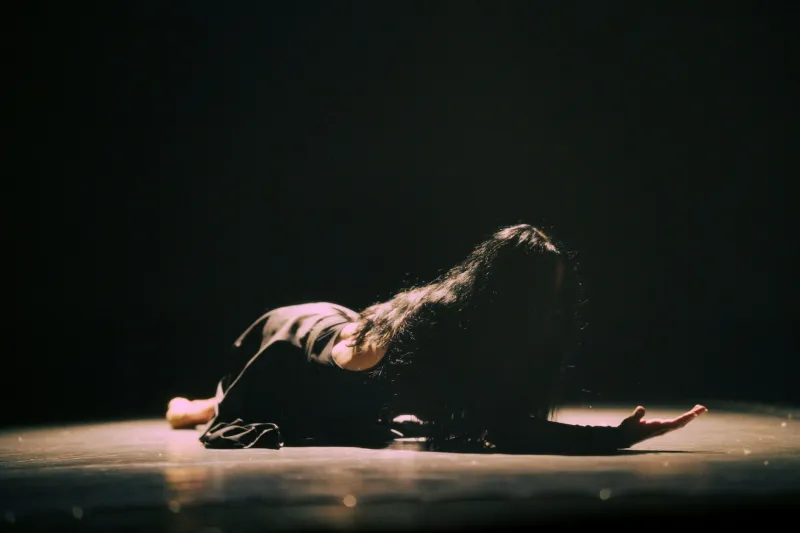
This connects directly to traditions like Japanese butoh dance or the understated performance style cultivated in Korean film, where actors are sometimes coached to think their character's thoughts rather than perform them. The result onscreen is a quality of interiority that American acting schools are increasingly incorporating into their curricula.
A Different Kind of Cinematic Nourishment
Here at 秀舞台, we talk a lot about the ways Asian culture offers Americans an alternative vocabulary—for wellness, for beauty, for ambition. Cinema is no different. The art of the pause, the power of what's left unsaid, the trust placed in an audience to complete the emotional circuit—these aren't just stylistic preferences. They're a philosophy about human attention and human connection.
In a media landscape that's constantly fighting for your eyeballs, there's something quietly radical about a film that's willing to look away. And there's something telling about the fact that so many American viewers, given the choice, are choosing to look with it.
The silence isn't empty. It never was. It just took a while for us to hear what it was saying.