Moving Through It: How Asian Performance Arts Are Quietly Becoming America's Most Unexpected Therapy
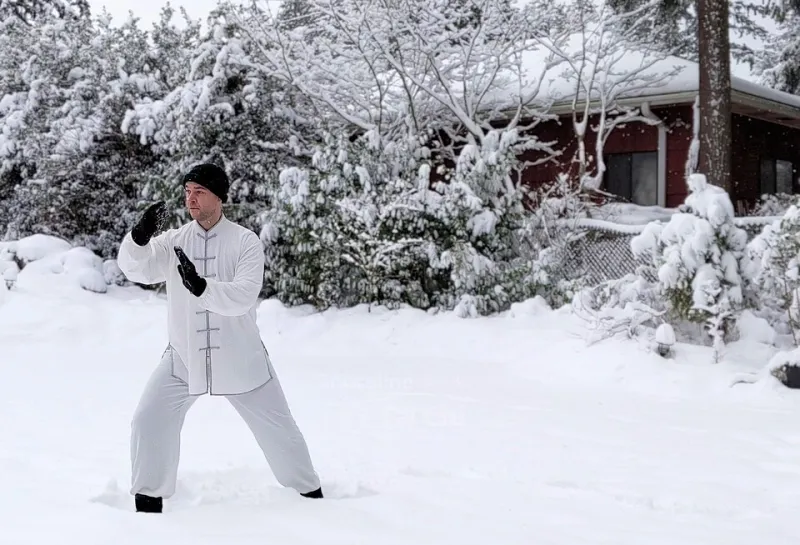
Photo: ShorelineTaiji, CC BY-SA 4.0, via Wikimedia Commons
Sarah Chen didn't expect a Tai Chi class to change her relationship with anxiety. The 26-year-old graphic designer from Portland had tried meditation apps, journaling, therapy, and a brief but intense relationship with cold plunges. Nothing quite stuck — until her therapist, somewhat casually, suggested she look into a Tai Chi practice being offered at a local community center.
"I went in totally skeptical," she admits. "I thought it was just slow-motion karate for old people." Six months later, she practices four times a week and describes it as the most effective mental health tool she's ever used. "It's the only thing that actually gets me out of my head."
Sarah is not alone. Across the United States, a quietly growing movement is bringing traditional and contemporary Asian performance arts — Tai Chi, Chinese classical dance, qigong-based movement theater, even lion dance — into wellness spaces, therapy practices, and university counseling programs. What was once seen as cultural performance is being recognized, increasingly, as medicine.
The Science Behind the Slow
To understand why this is happening now, it helps to understand what these practices actually do to the body and brain.
Tai Chi, for example, is classified by the National Institutes of Health as a mind-body practice, and the research supporting its mental health benefits has been building steadily for years. Studies published in journals like JAMA Internal Medicine and Frontiers in Psychology have linked regular Tai Chi practice to reduced cortisol levels, improved sleep quality, decreased symptoms of depression, and enhanced cognitive function in older adults. A 2021 meta-analysis found it comparable to conventional exercise therapy for anxiety reduction.
But licensed therapists who are incorporating these practices into their work say the numbers only tell part of the story.
"What Tai Chi does that traditional talk therapy sometimes struggles with is it brings the nervous system into the conversation," explains Dr. Marcus Webb, a somatic therapist based in Chicago who has integrated movement practices from several Asian traditions into his clinical work. "Trauma lives in the body. When you're doing these slow, intentional movements — especially ones that are connected to breath and to a philosophical tradition — you're not just exercising. You're reprogramming how your body responds to stress."
Dr. Webb points specifically to the concept of liuhe — the six harmonies in Chinese martial and dance traditions — which describes a coordination between the internal (mind, breath, intention) and external (body, movement, form). "That framework is actually incredibly aligned with what somatic therapy is trying to achieve," he says. "We just never had the language for it until we started paying attention."
Contemporary Chinese Dance Finds a New Audience
Beyond Tai Chi, contemporary Chinese dance — a form that blends classical Chinese movement vocabularies with modern choreography — is finding an unexpected audience in American wellness communities.
Studios in cities like New York, Los Angeles, Houston, and Seattle are reporting waitlists for beginner Chinese dance workshops, with demographic breakdowns that would surprise anyone who assumes these classes are only for Asian-American participants. Roughly 40 percent of students in some of these programs identify as non-Asian, and many cite mental health and mindfulness as their primary motivation for showing up.
"People come in thinking they're going to learn a dance," says Mei Lin, who runs a Chinese classical dance studio in the San Gabriel Valley and recently launched an online wellness-focused movement series. "They leave feeling like they've had a therapy session. That's not an accident — the form was designed to cultivate emotional expression and internal awareness. It's built into the choreography."
Mei has started collaborating with a local therapist to offer what they're calling "movement integration" workshops — sessions that pair Chinese dance fundamentals with guided reflection. The waitlist is three months long.
Gen Z Is Leading the Charge
If there's one demographic driving this cultural shift, it's Gen Z — and their motivations are worth understanding.
This is a generation that grew up with unprecedented access to mental health language and, simultaneously, unprecedented rates of anxiety and depression. They're also deeply skeptical of one-size-fits-all wellness solutions. Many have tried the apps, the supplements, the breathwork classes. They're looking for something with roots — something that feels earned rather than manufactured.
Asian performance traditions offer exactly that. There's a credibility that comes with a practice that has survived for centuries, that has a philosophy attached to it, that isn't trying to sell you anything beyond the discipline itself.
"I think we're also in a moment where young people are genuinely curious about non-Western ways of understanding the mind and body," says Dr. Priya Nair, a psychologist at a Bay Area university counseling center that recently piloted a qigong program for students. "There's an openness that maybe wasn't there before. And honestly, when you look at the mental health crisis on college campuses right now, we need every tool we can get."
The qigong pilot, which ran for eight weeks last semester, showed measurable reductions in self-reported anxiety scores among participants and prompted the university to fund a full-year program.
The Cultural Respect Question
Any honest conversation about Asian cultural practices being adopted in American wellness spaces has to grapple with the question of cultural respect — and where the line is between appreciation and appropriation.
Most practitioners and cultural stewards we spoke with land in a nuanced place. The concern isn't that people outside Chinese culture are practicing Tai Chi or learning Chinese dance — the concern is that the cultural and philosophical context gets stripped away in the process of commercialization.
"When a wellness app sells a '10-minute Tai Chi session for stress relief' with no mention of its origins or depth, that's where it starts to feel disrespectful," says Mei. "But when someone comes to learn the form, understands where it comes from, and builds a real relationship with the practice — that's exactly what these traditions were meant to do. They were always meant to be shared."
The teachers, therapists, and cultural practitioners doing this work thoughtfully are careful to keep the lineage visible. That context isn't a footnote — it's part of what makes the practice work.
A Stage for Healing
At 秀舞台 XiuStage, the name says it all: the stage is a place of expression, transformation, and connection. What we're witnessing right now in American wellness culture is a recognition that the stage — whether it's a Tai Chi circle in a park, a contemporary Chinese dance studio, or a qigong session at a university counseling center — can also be a place of healing.
Sarah Chen, our Portland graphic designer, puts it simply: "I finally feel like I'm in my body. Not just surviving in it — actually living in it."
Sometimes the most powerful wellness tools aren't the newest ones. Sometimes they've been waiting, patient and ancient, for us to finally pay attention.