Logging Off, Tuning In: Why Young Americans Are Embracing Ancient Asian Ideas About Doing Nothing

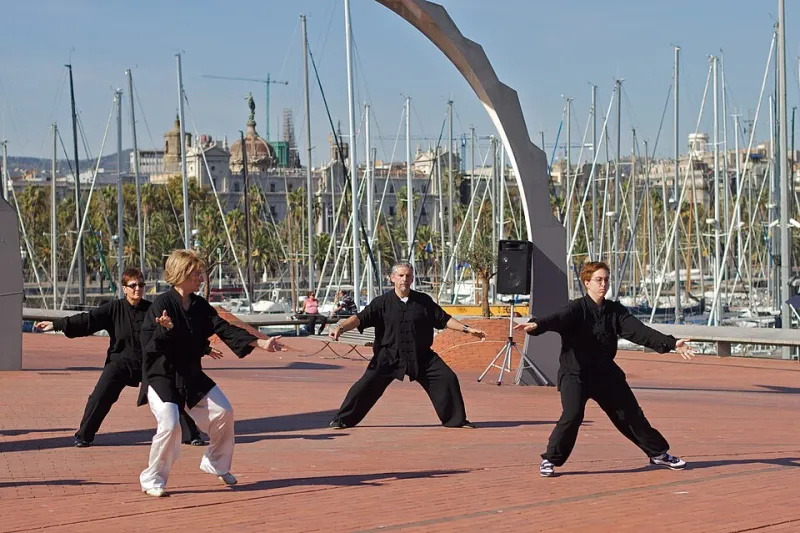
Photo: MIKI Yoshihito, CC BY 2.0, via Wikimedia Commons
Here's an irony worth sitting with: the generation that grew up native to social media is increasingly using social media to broadcast their rejection of social media. TikTok videos about quitting TikTok rack up millions of views. Instagram reels about going analog get thousands of saves. And somewhere in the middle of this very online conversation about being less online, something genuinely interesting is happening.
Young Americans — particularly those in their late teens and twenties — are discovering that the antidote to digital overwhelm might be found not in a new app or a productivity hack, but in philosophies that are hundreds, sometimes thousands, of years old. And a significant number of those philosophies are coming from Asia.
The Concept of 'Ma': Emptiness as a Feature, Not a Bug
In Japanese aesthetics, ma (間) is one of those concepts that doesn't translate cleanly into English. It's often described as "negative space" or "meaningful pause" — the silence between musical notes, the empty room that defines a home, the breath between words that gives a conversation its weight. Ma is not the absence of something. It's the presence of space itself.
For a generation raised on infinite scroll and notification pings, the idea that emptiness could be intentional — even valuable — is quietly revolutionary.
"I first came across ma in an art history class and I literally stopped taking notes," says Chloe Nguyen, a 23-year-old graphic design student in Chicago. "I'd been feeling this constant pressure to fill every minute, post every thought. And here was this entire philosophy built around the idea that the gaps are where meaning lives. That hit different."
Chloe is not alone. Online communities centered around ma, wabi-sabi, and related Japanese aesthetic philosophies have grown substantially over the past two years, with Reddit threads and Discord servers attracting thousands of members who share everything from minimalist room photos to journal prompts rooted in the concept of intentional emptiness.
Korean 'Slo-Living' and the Quiet Aesthetic
If ma is the philosophical foundation, Korean slow-living — sometimes called slo-living in Korean wellness circles — is the lifestyle expression that Gen Z Americans are finding most immediately accessible.
The Korean slow-living movement, which gained momentum in South Korea partly as a response to the country's notoriously high-pressure work culture (ppalli ppalli, or "hurry hurry," is practically a national ethos), emphasizes deliberate pacing, sensory attention, and the cultivation of small pleasures. It overlaps with hygge and lagom in some ways, but carries a distinctly Korean texture: careful tea preparation, long evening walks without earbuds, the ritual of a multi-step skincare routine approached as meditation rather than maintenance.
American wellness marketing has already started catching on. Brands selling everything from linen loungewear to pour-over coffee equipment are leaning into slow-living language, often nodding explicitly to Korean and Japanese influences. But the young people actually practicing this lifestyle are quick to distinguish between the aesthetic and the substance.
"There's a version of slow living that's just buying expensive candles and calling it mindfulness," says Marcus Webb, a 26-year-old teacher in Austin who has been documenting his own digital detox journey through a private newsletter rather than social media. "What I'm actually trying to do is change my relationship with time. That's a lot harder than it looks and it has nothing to do with shopping."
Chinese Philosophy and the Art of Strategic Stillness
Beyond Japan and Korea, Chinese philosophical traditions are also finding new audiences among young Americans seeking alternatives to the attention economy's demands.
Taoist concepts like wu wei — often translated as "non-action" or "effortless action" — describe a way of moving through the world that doesn't force outcomes but rather aligns with natural rhythms. It's a principle that sounds almost radical in a culture that treats busyness as a status symbol and rest as something you earn after productivity.
Confucian ideas about reflection and self-cultivation (xiū shēn, 修身) are also experiencing a quiet resurgence, particularly in academic and professional communities where the relentless optimization mindset is starting to show its cracks.
"I think people are realizing that the productivity culture sold to them is actually making them less effective and less happy," observes Dr. Susan Lin, a cultural psychologist at UC Berkeley who studies how Asian philosophical frameworks are being adopted and adapted in Western contexts. "These ancient ideas aren't being imported wholesale — they're being remixed through a very American lens. But the core insight, that stillness has value and that constant stimulation is not the same as living, is landing."
What It's Doing to Consumer Habits
The behavioral shifts accompanying this philosophical drift are concrete and measurable. Book sales for physical journals, fountain pens, and analog planners have risen consistently since 2022. Vinyl record sales in the U.S. hit a 35-year high last year. Film photography communities — particularly on platforms like Flickr and in-person clubs — are attracting members who explicitly cite digital fatigue as their motivation.
Perhaps most tellingly, community-based, screen-free social experiences are seeing renewed interest. Tea ceremony workshops, ikebana (Japanese flower arranging) classes, and Korean maedeup (traditional knotting craft) sessions are being offered in cities across the country — and filling up fast with participants in their twenties and thirties.
"My ikebana class has a two-month waitlist," says Yuki Hashimoto, who teaches the practice in Seattle. "Most of my students are young professionals. They tell me they just want somewhere to be that doesn't ask anything of them except presence."
Presence. That might be the most countercultural thing a young American can practice in 2025.
The Paradox Doesn't Resolve — And That's Kind of the Point
Yes, the irony remains: much of this slow-living conversation is still happening on the very platforms people are trying to escape. But perhaps that's not a contradiction so much as a transition — a generation working out loud as it figures out a different relationship with the tools it's been handed.
What's clear is that the philosophical vocabulary being reached for in that process is increasingly Asian in origin. Ma. Wu wei. Slo-living. These aren't exotic imports being exoticized — they're frameworks that are resonating because they offer something the scroll genuinely cannot: the radical suggestion that you are already enough, and that the most meaningful thing you might do today is simply stop.