From Dojo to Therapy Couch: How Martial Arts Philosophy Is Quietly Transforming American Mental Health
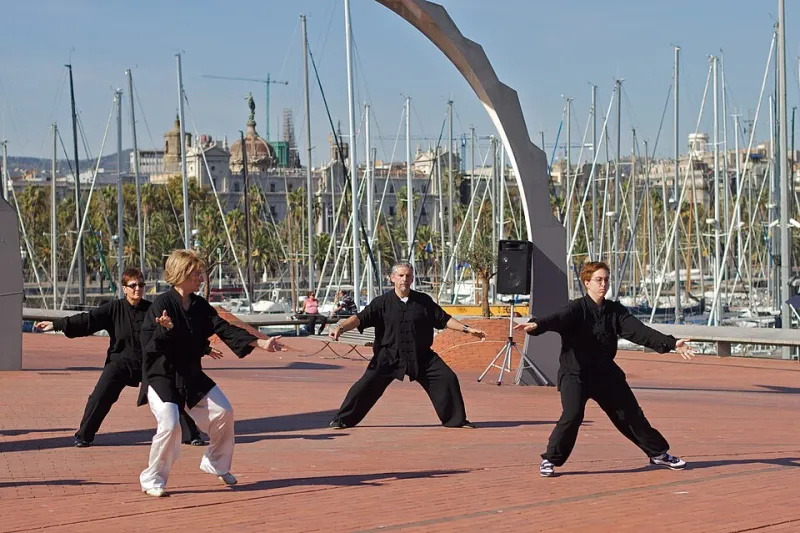
Photo: cogdogblog, CC BY 2.0, via Wikimedia Commons
When Dr. Lisa Huang, a licensed clinical psychologist based in San Francisco, first started weaving concepts from traditional kung fu into her therapy sessions, she expected pushback. "My colleagues thought it was a little out there," she laughs. "But my clients? They got it almost immediately."
What Dr. Huang is doing isn't fringe anymore. Across the United States, a quiet but meaningful shift is underway — one where the philosophical foundations of Asian martial arts are showing up in therapist offices, corporate retreat agendas, and trauma recovery programs. It's not about learning to throw a punch. It's about learning to sit with discomfort, breathe through chaos, and find stillness within struggle.
The Philosophy Behind the Fist
Most Americans think of martial arts as a physical discipline — kicks, blocks, forms, sparring. But anyone who has spent serious time studying kung fu, tai chi, or aikido will tell you the physical is almost secondary. The real curriculum is internal.
Concepts like wu wei (non-forceful action), jing (cultivated stillness), and the acceptance of opposing forces — the yin and yang at the heart of so much traditional Asian thought — form the philosophical backbone of these practices. Struggle isn't something to be eliminated in this worldview; it's something to be moved through with awareness and intention.
"That reframing alone is enormously powerful for people dealing with anxiety or depression," says Marcus Webb, a licensed therapist in Chicago who trained in Wing Chun for over a decade before integrating martial philosophy into his clinical work. "Western psychology often positions mental suffering as a problem to be solved. Martial philosophy says: this is part of the path. Let's learn to walk it better."
Breath First, Everything Else Second
If there's one element from Asian martial traditions that has gained the most traction in American therapeutic spaces, it's breathwork — specifically the disciplined, intentional breathing patterns central to practices like tai chi and qigong.
Tai chi's slow, deliberate movements are inseparable from its breathing rhythms. Practitioners learn to synchronize inhale and exhale with every shift of weight, every rotation of the torso. It sounds simple. The neurological effect, however, is anything but.
Research published in journals like Frontiers in Human Neuroscience has documented how slow, patterned breathing activates the parasympathetic nervous system — essentially hitting the body's reset button on the stress response. Therapists working with trauma survivors, veterans with PTSD, and clients managing chronic anxiety are increasingly prescribing tai chi or qigong-adjacent breathing exercises alongside traditional talk therapy.
"I had a client who had tried every medication on the list," Dr. Huang recalls. "When we introduced a qigong breathing protocol — just ten minutes a day — her sleep improved within three weeks. The science is there. We just hadn't been looking in this direction."
Corporate America Gets a Lesson in Yielding
It's not only clinical settings where this philosophy is landing. Some of the most enthusiastic adopters are in boardrooms and open-plan offices.
Companies like Salesforce, Aetna, and a growing list of Bay Area startups have incorporated tai chi and mindful movement sessions into their wellness programming. But forward-thinking HR directors are going deeper, bringing in practitioners who teach the philosophy — not just the movements.
The concept of yielding from aikido, for example — the idea that you neutralize force by moving with it rather than against it — has become a surprisingly effective framework for conflict resolution training. "We ran a workshop for a mid-size tech company in Austin," says Jordan Lim, a martial arts instructor and corporate wellness consultant. "We taught their management team the principle of receiving force without resistance. Then we applied it directly to how they handle difficult conversations with employees. The feedback was incredible."
The appeal makes sense. In a culture that celebrates hustle and equates resistance with strength, a philosophy that reframes yielding as a form of sophisticated power feels genuinely counterintuitive — and therefore genuinely useful.
Mind-Body Integration: Not a Metaphor
One of the more scientifically compelling aspects of martial arts philosophy, from a mental health standpoint, is its insistence that the mind and body are not separate systems. This isn't poetic language — traditional Asian medicine and martial thought have operated from this premise for thousands of years.
Western psychology is catching up. Somatic therapy, which focuses on the body's role in storing and processing trauma, has grown substantially in popularity over the past decade. Practitioners like Peter Levine (whose Somatic Experiencing model is widely used) draw on some of the same insights that martial arts teachers have been articulating for centuries: that the body holds what the mind can't always access.
"Kung fu training teaches you to notice where you're holding tension before you even consciously register an emotion," says Dr. Huang. "That's exactly the kind of somatic awareness we're trying to build in trauma-informed therapy. The traditions were already there. We're just translating them."
Finding Your Dojo (Even Without One)
You don't need to find a traditional martial arts school to access this philosophy — though that's certainly an option, and a good one. Community tai chi classes are increasingly common in public parks from New York's Chinatown to Los Angeles's Griffith Park. Many YMCAs and community centers now offer qigong sessions.
For those more comfortable starting at home, apps like Qigong for Beginners and YouTube channels run by certified tai chi instructors have made the entry point lower than ever. The key, practitioners and therapists agree, is consistency over intensity. Ten minutes of mindful movement daily will do more for your nervous system than an occasional hour-long class.
The deeper invitation — to sit with discomfort, to breathe through resistance, to accept struggle as part of the path — is available anywhere, anytime. No belt required.
"What I tell my clients," Marcus Webb says, "is that these traditions have been stress-tested for centuries. Not in labs — in life. That's a kind of evidence we shouldn't ignore."