Quiet Ambition: How Ancient Asian Ideas About Stillness Are Rewriting the American Success Playbook
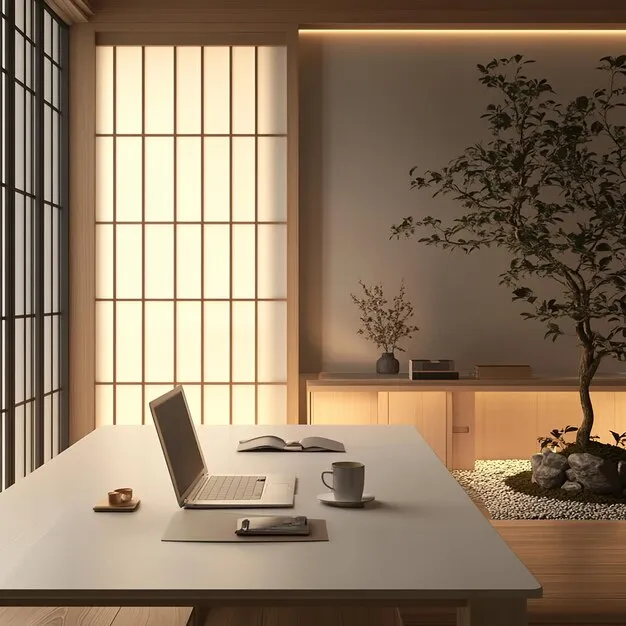
Photo: minimalist Japanese workspace quiet professional focus zen, via img.freepik.com
For the better part of a decade, American career culture wore its exhaustion like a badge of honor. You hustled. You grinded. You answered emails at midnight and bragged about it at brunch. But somewhere between the fourth productivity app download and the third burnout, something shifted. A quieter way of working — one that's been practiced across Asia for centuries — started making a lot of sense to a generation that had been running on fumes.
This isn't about doing nothing. It's about doing the right things, in the right headspace, with the kind of focused intentionality that most open-plan offices and Slack notification cultures actively work against. And increasingly, the philosophical toolkit for getting there is coming from East Asia.
The Space Between: Japan's 'Ma' and Why Emptiness Isn't Wasted Time
In Japanese aesthetics and design, there's a concept called ma (間) — roughly translated as "negative space" or "meaningful pause." It's the silence between musical notes that gives a melody its shape. The gap in a conversation that lets an idea breathe. In architecture, it's the empty room that makes the occupied one feel intentional.
Applied to work, ma reframes the moments we typically label as "unproductive" — a quiet lunch alone, a few minutes of stillness before a big meeting, the deliberate pause before responding to a difficult email. Rather than filling every gap with noise or activity, ma asks you to treat emptiness as an active ingredient in good thinking.
American professionals who've started incorporating this idea often describe it less as a technique and more as a mindset shift. Instead of context-switching every eight minutes, they're building deliberate pauses into their workday — not as breaks from productivity, but as part of it. The result, many say, is work that feels less reactive and more considered.
Reading the Room, Korean Style: The Career Power of 'Nunchi'
If ma is about your relationship with silence, nunchi (눈치) is about your relationship with other people's silence — and everything else they're not saying out loud.
Korean culture places enormous value on this concept, which loosely translates to "the subtle art of gauging the room." Someone with good nunchi picks up on unspoken social cues, adjusts their energy accordingly, and knows when to speak, when to hold back, and when a situation calls for a completely different approach than the one they'd planned.
In American workplaces — where directness is generally prized and "reading the room" is often treated as a soft skill rather than a strategic one — nunchi offers something genuinely underrated: the ability to navigate complex interpersonal dynamics without burning bridges or missing what's actually being communicated.
This is especially relevant in cross-cultural professional settings, which are increasingly common in US cities and industries. The colleague who doesn't push back in a meeting isn't necessarily agreeing. The client who says "that's interesting" might be politely signaling concern. Nunchi trains you to notice the gap between what's said and what's meant — and to respond to both.
Chinese Philosophy and the Art of Strategic Withdrawal
There's a concept in classical Chinese thought, drawn from Taoist philosophy, sometimes described as wu wei (無為) — often translated as "non-action" or "effortless action." It doesn't mean passivity. It means aligning yourself so precisely with the situation at hand that your effort feels natural rather than forced, like water finding its way downhill.
For ambitious Americans trained to equate visible effort with value, wu wei is genuinely countercultural. It suggests that the most effective move isn't always the most aggressive one — that sometimes the smartest strategy involves stepping back, letting things develop, and acting only when the timing is right.
In practical career terms, this might look like resisting the urge to chime in on every meeting agenda item. Choosing not to pursue a promotion that looks good on paper but doesn't align with where you actually want to go. Or simply giving a project room to breathe instead of over-engineering it into the ground.
It's a philosophy that's quietly finding fans among American professionals who've noticed that their most exhausting efforts often produce the least satisfying results.
The Silence Economy Is Already Here
You can see the cultural shift happening in real time. Deep work retreats — where phones are banned and schedules are deliberately sparse — are selling out. Productivity frameworks that emphasize single-tasking over multitasking are going mainstream. "Slow productivity," a term popularized by writer Cal Newport, is drawing huge audiences among people who are done performing busyness for its own sake.
What's striking is how naturally these Western articulations of focused work align with Asian philosophical traditions that have been making the same argument for centuries. The hunger clearly exists. The frameworks were already there — just waiting to be rediscovered.
Some companies are starting to take notice. A handful of forward-thinking US firms have experimented with "no meeting" blocks, asynchronous communication policies, and even designated quiet spaces designed to support the kind of uninterrupted concentration that most open offices systematically destroy. The results, in terms of both output quality and employee wellbeing, have been encouraging enough that more are following suit.
What This Means for How We Define Success
Maybe the most interesting thing about this shift isn't the productivity angle — it's what it says about how a generation is redefining ambition itself.
For a long time, American career culture equated success with volume: more hours, more output, more visibility, more noise. The Asian philosophies gaining traction now offer a fundamentally different equation. Success, in these frameworks, is less about how much you produce and more about how clearly you see — yourself, your environment, the people around you, and the moments that actually matter.
That's not a rejection of ambition. If anything, it's a more demanding version of it. Knowing when to pause, when to listen, when to do nothing — and doing all of it with genuine intention — takes more self-awareness than grinding ever did.
The silence economy isn't about opting out. It's about opting in, more carefully, to the things worth doing.