Five Minutes, One Small Pot: The Office Tea Ritual Slowly Replacing the 3 PM Coffee Run
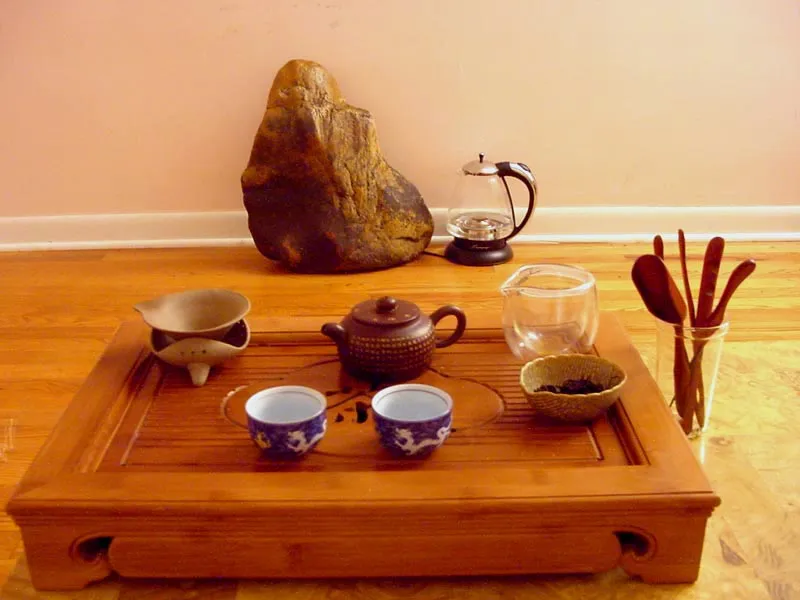
Photo: Neptunati, Public domain, via Wikimedia Commons
There's a moment in every gongfu tea session that beginners find almost offensive: the first steeping gets poured out. Rinsed away, gone. It sounds wasteful until you understand what's actually happening — you're waking the leaves, not drinking them. The good stuff comes later.
It's a decent metaphor for how a growing number of American workers are approaching their afternoons, too.
The Desk That Became a Tea Table
Walk through certain offices in the Bay Area or Manhattan's Chinatown-adjacent tech hubs and you might spot it: a small clay pot or lidded gaiwan, a pitcher, a few thimble-sized cups, and someone pouring hot water over leaves for the fourth or fifth time instead of microwaving a third latte.
Gongfu cha — literally "making tea with skill" — is the traditional Chinese method of brewing tea in small vessels with a high leaf-to-water ratio and short, repeated steepings. Where a Western mug of tea might get one long dunk, a gongfu session might stretch a single portion of oolong across eight or ten infusions, each one revealing a slightly different side of the leaf.
For Lin Wei, a tea educator who runs workshops in Portland, the appeal for her American students isn't exoticism. It's structure. "People tell me they don't have time for tea ceremony," she says. "But they have time to scroll. The session is only as long as you decide. Five minutes is a complete session."
Why the Ritual Works When a Coffee Break Doesn't
There's real science behind why a repeated, physical ritual hits differently than a regular break. Behavioral researchers have long noted that rituals — even arbitrary ones — reduce anxiety by giving the mind a defined container. You can't ruminate about your inbox while counting a ten-second pour.
Coffee, for all its virtues, is optimized for throughput. You grab it, you go, you keep working. Gongfu cha is optimized for interruption. The water needs a moment. The leaves need a moment. Each steeping lasts thirty seconds to a minute, and the tea itself practically demands that you sit down for it. The cup is two sips' worth. You'll be back at the pot in a minute whether you like it or not.
That enforced return is the point. You're not taking one long break; you're taking six tiny ones, strung together like beads. For workers whose days have collapsed into an undifferentiated scroll of Slack pings and calendar holds, that rhythm — steep, pour, sip, repeat — can feel almost radical.
The Gear Question (You Need Less Than You Think)
Here's the part where most guides lose people: the gear. Traditional gongfu setups can get gorgeous and expensive, with Yixing clay pots that cost more than a nice chair. Ignore all of that for now.
A legitimate beginner's kit:
- One gaiwan (a lidded bowl, roughly 100–150ml). It costs $10–15 and does everything a teapot does, with more honesty about how hot the cup is.
- One small cup. Or honestly, a shot glass.
- Any oolong or black tea from a reputable shop. Don't start with delicate green teas; they're punishing when brewed strong and fast.
- Kettle water just off the boil. No thermometer required at first.
The five-minute practice looks like this: rinse the leaves with a quick pour and dump. Then steep for about twenty seconds and pour into your cup. Drink. Steep again, adding five to ten seconds each round. Somewhere around the fourth or fifth infusion, notice that the tea has changed — softer, sweeter, different. That noticing is the whole practice.
A Different Relationship With the Afternoon
What strikes most newcomers isn't the flavor — though a good Tieguanyin at the fifth steeping is a genuine revelation. It's the way the session reframes time. Coffee culture treats the afternoon as an obstacle to power through. Gongfu culture treats it as something to move through in stages, each one distinct.
Some practitioners have started keeping what they call a "session log," noting which teas they drank and how the steepings evolved. It sounds like tea-nerd overkill until you realize what they're actually doing: keeping a record of having paid attention, day after day.
The leaves, for their part, keep giving. Long after a coffee pod would've been tossed, a quality oolong is still unfolding — sixth steep, seventh steep, a little quieter each time but still there. That's not a bad model for how to meet the last hours of a workday. Not with a jolt. With one more pour.